
With a successful medical career, this researcher pursues his dream job
2021년 2월 23일
저자: Alison Bert, DMA

Dr Seng Cheong Loke is designing an augmented reality app to help older people communicate with their families
Pictured above: Seng Cheong Loke, MD, is a PhD candidate in Medical and Health Sciences at the University of Auckland in New Zealand. If you were to read the “Research Interests” section on Dr Seng Cheong Loke’s curriculum vitaeopens in new tab/window, you might think something was amiss. The list details his work with calcium and parathyroid disorders, diabetes mellitus, gerontology and stem cell therapy.
But then there’s the final line:
Computer vision technology, machine learning, and low light imaging.
There’s no error here, however. And his story is even more interesting that the version on paper.
Seng Cheong was an esteemed endocrinologist in his home country of Mayasia, where he headed the Clinical Endocrinology unit at the Kuala Lumpur General Hospital. In an effort to spend more time with family, he made his first career transition — to academia. He took a concurrent position at Universiti Putra Malaysiaopens in new tab/window. While working his way up to Associate Professor, he conducted extensive research, held various administrative posts and co-chaired the National Stem Cell Therapy Clinical Registry for the Ministry of Health.
Then, when he was still in his 40s, he had a change of heart. You see, it was never his dream to be a doctor.
He laughed, recalling the decision he made when he was 20 years old:
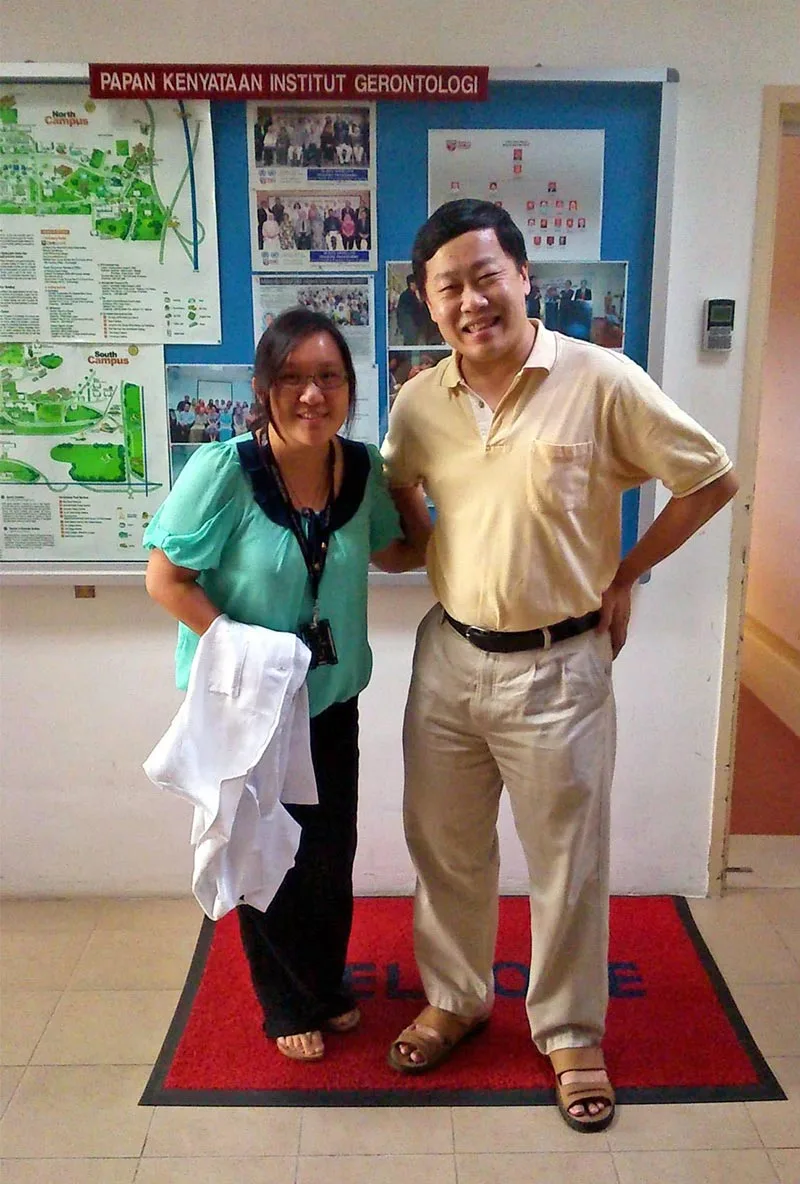
Prof Seng Cheong Loke, MD, with a graduate student at the Institute of Gerontology, Universiti Putra Malaysia.
I was one of those typical Asian kids, right? Mother says, ‘You know, elder son, you must be a doctor or a lawyer — preferably a doctor.’ So I went into medicine not really being too excited about it.
But what I really wanted when I was young was to actually do something computer-related.
One evening, he sat down to talk with his family. He had an opportunity to pursue a PhD at the University of Aucklandopens in new tab/window in New Zealand while also serving on their Faculty of Medical and Health Sciences.
“It’s a bit late in my career,” he said, “but we talked about actually moving to New Zealand.”
He had applied to pursue a PhD in Health Sciences with a goal to merge his health and gerontology expertise with his lifelong interest in technology. His primary supervisor is in the School of Computer Science.
Augmented reality for seniors
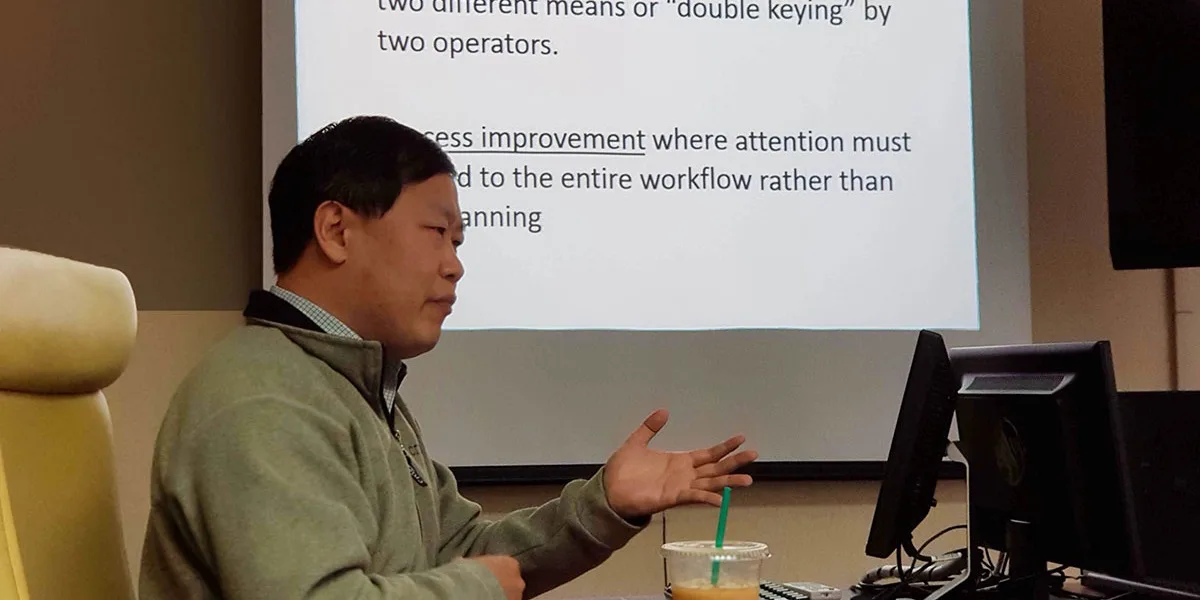
Dr Seng Cheong Loke gives a presentation on imaging technology for senior academics at the Universiti Putra Malaysia.
As a doctoral student, Seng Cheong is designing an augmented reality app that would enable older people to have a real-life experience when communicating with relatives they cannot visit in person. He explained:
For older people, especially when they've lived in their family home for many years, having a sense of relatives visiting — virtually if not physically — may be something that is of benefit to them.
The tool he’s developing would “project the remote viewer into the local environment.” In other words, the “visitors” on the video call would appear to be in the host’s own space.
If the user wanted to view the call on their tablet or smartphone, the device’s camera would take a live video of their room, and the visitor would appear to be there with them.
In his experiments, Seng Cheong is using avatars to test while collecting data to test the efficacy of various routines for background segmentation: “With my research, I'm actually projecting different kinds of avatars onto the local environment,” he said, explaining that he’s comparing a standard 2D avatar and video frame with a 2.5D or 3D avatar that can be viewed from various angles.
For the next step, he’s going to collect data on how people react to it: their physiological responses along with self-reported experiences of “presence.”
Right now, limits to the cameras in mobile devices mean the viewing experience won’t be optimal. With humor, he explained:
I’m restricted to projecting the person's head. I’ve already got the digital head working: he looks at you and talks to you and stares at you. But, you know, looking at a disembodied head can be disconcerting for some older people, which is why I’m carefully choosing the first test candidates to make sure they have healthy hearts.
So it’s not going to be the best, but it's a trial of new tech to see whether it makes a difference to them.
If that works, the next step will be to design a multicamera system that can be used to project a person’s presence onto an augmented reality headset.
Thinking outside the (camera) box
Although Seng Cheong has had a lifelong interest in technology, it’s not his professional background – and he considers that an advantage when it comes to thinking creatively.
While there are various tools like Zoom and Skype for people to communicate virtually, Seng Cheong came up with an idea to enhance this experience in a unique way:
What I'm essentially testing is the concept of a presence. For example, if I were to talk with someone directly, I'm actually present in front of them. But when you're actually communicating with somebody remotely, you're actually trying to project your presence far away in front of the person. So the degree of effectiveness of a communication tool is measured by its ability to project yourself from here to there in front of the person.
For many years, the telephone was the gold standard. But with more recent developments in technology, Skype and Zoom have taken off. But then you have things like augmented reality and virtual reality, which may add new dimensions to our communication.
However, more capabilities do not not necessary translate into a better experience, Seng Cheong pointed out.
The thing is that the more dimensions, people assume that it's actually better, but that's not necessarily so. In fact, sometimes, the more realistic, you try to make it, the more people's brains try to find fault with what they see.
For this reason, he is building a prototype to test the technology with users before progressing to the next stage of his research.
Another challenge involves adapting his new technology to mobile devices.
The problem is, with only one camera there — and the fact that it's not designed for AR or VR — I'm trying to … shoehorn new technology into something that it's not really designed for.
The challenges has forced him to find many technical workarounds. But he’s pleased with the progress – much of which he attributes to his ability to look from the outside in.
In a sense, one of my advantages is that I’m not coming from computer science background. When I come into a new situation, I have to think laterally — I have to think out of the box — and I'm not constrained by previous preconceptions. So that allows me to develop new things where other people think they have done before, they have done it a lot of times as a standard way of doing it. But I find that if you look closely enough, sometimes even standard ways can be improved.
He gave an example from the field of computer graphics and computer vision and the ubiquitous use of deep learning:
You can hardly publish anything if you don't reference something to deep learning. But one of the problems with deep learning is that it is slow. You need to have powerful devices, or you need to use computers with advanced graphics cards in order to get to get it to run in real time. And developing this for a mobile device, I don't have a graphics card to lug around.
So what I've had to do is to find other ways of realizing the benefits of the deep learning technology while using static methods. One of the steps in my research involved speeding up the image segmentation, which is the part where you cut out the person from their background. I can speed it up over standard methods by a factor of 10 to 20 times.
On storing and sharing data

View from the window. Seng Cheong’s family lives in Army Bay, New Zealand.
To store and share his data, Seng Cheong uses Mendeley Dataopens in new tab/window:
I think one of the most important things is you need to have a platform that’s easily accessible. The problem is that some of the venues you can choose – they may be there right now, but in two years’ time may be gone off-line. So I wanted to choose a venue that is backed by a respectable organization that’s been there for many years so there’s persistence of the data store.
The second thing is that I want to have visibility in the sense that I would like to have a way to publicize the data. If you put it on a site like Mendeley, it will actually be indexed and referenced. there's just so much data out there that unless there's a way to find it, there’s no way additional data would actually surface for people to access it or even know about it. So I think search and reference is extremely important.
And finally, I needed enough space to actually store my data. The problem is that the data is very large. And I managed to compress it to about 6 GB gigabytes worth of data, which is a lot, but the original data set was about 12 GB. The thing is that when you're testing video and doing segmentation, even if you keep the resolution low, a lot of data goes there.
For this datasetopens in new tab/window, Seng Cheong was selected to receive the Mendeley Data FAIRest Datasets Awardopens in new tab/window. The award recognizes researchers or research groups that make their research data available for additional research and do so in a way that exemplifies the FAIR Data Principles opens in new tab/window– Findable, Accessible, Interoperable, Reusable.
Sharing data is important to Seng Cheong:
Research is all about publicizing what you found. There’s is no point doing research and keeping it under wraps for no one to use.
Advice for early-career researchers
Seng Cheong draws on his own experience when giving advice to his students and other early-career researchers:
I think one of the most important things is that, if you go into any kind of research, try to have an open mind. You know, we all have our preconceptions. When you go in, think about not only what you need to do – think about if there are better ways to get it done, and don't rely on on assumptions that other people make. … I think that's very important in any kind of research. And that's especially true in PhD work, where you have to break new ground.
The second thing I would say is that, just because a field has been gone over many times by experts, so-called, don't think that there's not a gap for you to actually contribute. There's always something that you can do. There's always something new that you will discover if you are persistent enough.
Award-winning data set
Loke is a recent winner of the Mendeley Data FAIRest Datasets Awardopens in new tab/window. The award recognizes researchers or research groups that make their research data available for additional research and do so in a way that exemplifies the FAIR Data Principles opens in new tab/window– Findable, Accessible, Interoperable, Reusable.View his data set on Mendeley Dataopens in new tab/window
기여자
