
Are you interested in this topic? Sign up for our Future Aligned newsletter.

Unfortunately we don't fully support your browser. If you have the option to, please upgrade to a newer version or use Mozilla Firefox, Microsoft Edge, Google Chrome, or Safari 14 or newer. If you are unable to, and need support, please send us your feedback.
Explore how universities can build a connected, future-ready digital ecosystem that supports research excellence, operational efficiency and improved student outcomes with interoperable Elsevier solutions.

This is a challenging time for the higher education sector. Many universities face a combination of pressures including government funding cuts, declining enrollments and the need to integrate new technologies on both the infrastructure and human levels. At the same time, there is a growing debate around the position of academia in wider society and the relevance and impact of its teaching and research outputs.
Institutions are responding to this situation by prioritizing operational efficiency and diversifying their revenue streams. Urged on by governments, funders and the changing expectations of taxpayers, they are also working to demonstrate the real-world impact of their research and embed themselves in local economic ecosystemsopens in new tab/window where they can directly contribute to industry and the wider community. Underlying all these measures, however, is a shared requirement: the need to provide the right technological and cultural foundation for change through well-planned digital transformation programs.
In its classic academic definitionopens in new tab/window, digital transformation is characterized as “a series of deep and coordinated culture, workforce and technology shifts that enable new educational and operating models and transform an institution’s business model, strategic directions and value proposition.” Understandably, the end point of a redefined university value proposition will be highly attractive to many academic leaders, especially at a time when the idea of a new social contract for higher education is being widely discussed. But how does this translate into day-to-day operational changes? At a basic level, digital transformation aims to replace fragmented legacy systems with integrated platforms and processes across the main functional areas of the university. This shift reduces administrative burden and helps curb cybersecurity risks. It should also be accompanied by improved governance, digital literacy and data awareness among students and staff – just as we have seen with recent AI adoptions, but extended to the whole IT infrastructure. The end goal is to support the emergence of a more collaborative and user-centric institutional culture.
What about the university’s two major outputs, research (knowledge creation, innovation) and education (knowledge development, graduate outcomes, human capital), and their respective impacts? In the brave new world of digital transformation, researchers are equipped with advanced tools that can accelerate workflows, expedite collaboration and enable more efficient data analysis. They can showcase their work and demonstrate its real-world influence more effectively, thanks to centralized systems and standardized data formats. These allow them to combine quantitative and qualitative evidence into more accurate and comprehensive impact narratives, without compromising cyber or knowledge security. This same consolidation also provides leaders with more actionable insights that enable better real-time decision making – for instance, in staff recruitment or resource allocation. For education, student outcomes are supported by seamless 24/7 access to services, more personalized learning experiences and modern, digital-first communication channels.

This vision of a technologically integrated, highly efficient university – where users are empowered based on their specific needs – is undeniably alluring, but how attainable is it in practice? There is no shortage of digital maturity models, including several optimizedopens in new tab/window for the needs of universities, that highlight where institutions may be on their respective transformation journeys – although it is important to note that technology and its socio-economic context continue to evolve rapidly, meaning this journey may never truly end.
While this might sound daunting, it is, after all, the role of senior academic leaders to be receptive to emerging opportunities, just as Chief Technology Officers and their teams must continuously work to assess, optimize and modernize universities’ IT infrastructures. Typically, this task involves a hybrid approach, combining vendor-supplied tools for core operations with self-built, custom systems designed to meet unique institutional needs. This combination, variously described as "build-plus-buy" or "buy-before-build," is as much a strategic choice as a technological one, allowing institutions to be agile in their deployment of new tools and technologies while keeping core systems running. It is a question of balancing external expertise and innovation with internal intellectual property and customization to create the most efficient and resilient system possible.
Universities pursuing this hybrid approach to digital transformation should use criteria such as interoperability, scalability and strategic alignment to inform their selection of vendor tools. While this could include a wide range of offerings – from CRM and enterprise management systems to AI workspaces for researchers – a concise checklist might run as follows:
Is the solution standard across the industry?
Can the solution grow with the institution and adapt to future needs?
How easily does the solution integrate with existing systems?
Does the solution offer an open API to facilitate integration with in-house proprietary systems?
Does the vendor comply with strict data privacy standards?
Does the vendor offer robust cybersecurity protocols?
Are AI solutions transparent, trained on reputable data and equipped with safeguards against bias?
Does the solution support user accessibility?
Does the solution align with university sustainability policies?
Does the vendor’s future product roadmap align with the university’s long-term digital vision?
Shaping an effective "build-plus-buy" strategy may be as much an art as a science, even when the leadership structures exist to ensure an enterprise-level approach is possible. However, applying criteria like the ones above can help universities build a flexible ecosystem that balances efficiency with innovation and enables the goals of digital transformation.
Elsevier offers a university-wide range of solutions, many of them – like the peer-reviewed literature platform ScienceDirectopens in new tab/window, or the abstract and citation database Scopus – used by leading universities across the world. At the same time, we recognize that our tools need to work both in conjunction with one another and in the context of an institution’s wider ecosystem.
This includes its IT infrastructure and strategic goals, including digital transformation itself. The best way of understanding how Elsevier supports this multifaceted process is to look at where its solutions are positioned in the main functional areas of the university. Building on the description shared in Institutional resilience in difficult times - The new case for digital transformation, this is shown below.
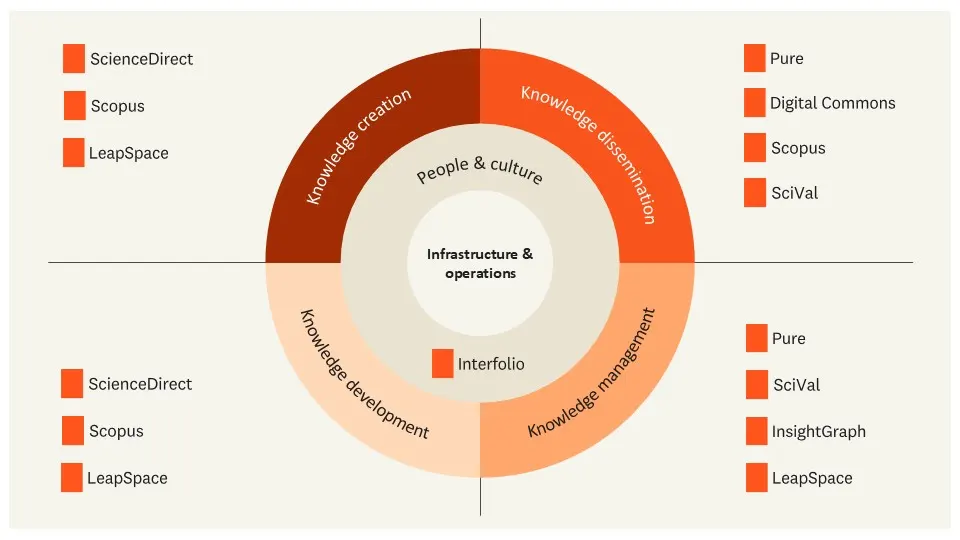
Interfolio Faculty Information System – Interfolio’s Faculty Information System (FIS) enables academic leaders to effectively manage the full academic lifecycle. It helps them streamline academic evaluation and make confident decisions with verified data and integrated workflows to support promotion and hiring. Interfolio also empowers academics to showcase their impact across teaching, research and service. Download our white paper to learn more about how Interfolio’s FIS supports digital transformation in higher education.
ScienceDirect – ScienceDirect is the premier platform for peer-reviewed scientific, health and technical literature. With peer-reviewed publications and cutting-edge research across disciplines, it equips institutions with the high quality trusted content and critical insights researchers need to drive discovery, innovate responsibly and deliver real-world impact. Scopus – Researchers and institutions need high-quality, unbiased insights to drive progress and make confident decisions. Scopus delivers rigorous quality control and transparent governance across its trusted content base, contextualizing research to help accelerate breakthroughs and deliver meaningful academic and institutional outcomes. LeapSpaceopens in new tab/window – LeapSpace is a curated, AI-powered workspace that helps researchers navigate and understand academic peer-reviewed content, extracting, summarizing and comparing insights from full text articles and book chapters across multiple publishers.
Pure – A leading Research Information Management System (RIMS), Pure’s public-facing portal allows institutions to showcase their research to a wider audience, including collaborators, funders and the public. For a high-level view of how a RIMS can support digital transformation, see Escaping the Catch-22 of digital transformation failure. For a more detailed account of how Pure can help, see How Pure supports digital transformation.
Digital Commons – The Digital Commons suite enables institutions to showcase the full breadth of their scholarly outputs through its comprehensive promotion, publishing, sharing and preservation capabilities.
SciVal – University leaders harness essential data from SciVal, a research analytics platform, to visualize research performance, benchmark against peers, develop collaborations and analyze research trends.
ScienceDirect – Elsevier’s journals and books on ScienceDirect can help students to meet course learning goals, from foundational knowledge to deeper explorations of a specialized field of study. A de facto community standard, the platform is a great place for students to develop information literacy skills.
Scopus – Scopus helps educators find resources to complement course materials. Students can use the platform to identify articles to inform the literature review process or understand the scholarly conversation around a topic through reference lists and cited articles.
LeapSpaceopens in new tab/window – LeapSpace helps students and educators quickly navigate the vast landscape of scholarly literature, developing a deeper understanding of complex topics and interacting with full text peer-reviewed content from multiple publishers. Quality data and responsible AI minimize the risk of hallucinations and bias, supporting AI literacy.
SciVal – By using publication, citation, patent, policy, funding and collaboration metrics, academic leaders can shape transformative research strategies and advance their institutional goals.
InsightGraph – A knowledge graph that enables real-time, cross-platform research ecosystem views. InsightGraph supports institutional decision-making by merging local data sources with trusted scientific datasets and public data, empowering them to evaluate and showcase their research ecosystem.
Pure – An interoperable software solution that centralizes institutional and grant metadata into a connected infrastructure. Pure unearths multifaceted insights about the overall research lifecycle, supporting both fact-based decision making and showcasing expertise. For more on the role of a RIMS in digital transformation, see Escaping the Catch-22 of digital transformation failure. For more on contribution that can be made by Pure, see How Pure supports digital transformation.
LeapSpaceopens in new tab/window – LeapSpace helps researchers find potential collaborators by identifying experts relevant to specific research topics. It also highlights funding opportunities on a topic-by-topic basis, providing details of funder preferences and success rates.
Elsevier can help you deliver on the promise of digital transformation. Our solutions combine data and technology with governance and expert human oversight, supporting you across a broad range of institutional needs. Readily integrated into your own systems, they can help you to manage information and processes, accelerate workflows and build actionable insights.
Universities are facing a series of epochal challenges around funding, student enrollments and their place in society as a whole. Technology is sometimes seen as part of the problem (unregulated AI integrations, cyber and knowledge security risks, the digital divide) and sometimes as part of the solution (streamlined processes, personalized learning, enhanced collaboration). While both viewpoints have value, what is usually missing is the institution-level perspective that offers the surest way of minimizing risk and optimizing promise. While this undoubtedly means working towards a properly integrated IT environment with the right data and governance protocols, the reach of a thriving digital transformation program extends far beyond the digital estate to enable wider cultural shifts across the university. This capacity to drive enterprise-level change – whether enhancing the student experience, reducing operational costs, or supporting internal collaboration – will be crucial to academic success in the years ahead.